what were the two defeats that led to napoleons losing paris and exile
/https://tf-cmsv2-smithsonianmag-media.s3.amazonaws.com/filer/37/f7/37f76041-e0f6-4087-8388-ec211c26a9fb/jun2015_j04_waterloo.jpg)
"Come full general, the matter is over, we have lost the day," Napoleon told one of his officers. "Let us be off." The mean solar day was June 18, 1815. Past almost viii p.m., the emperor of French republic knew he had been decisively defeated at a hamlet called Waterloo, and he was now not bad to escape from his enemies, some of whom—such as the Prussians—had sworn to execute him.
Less than an hour before, Napoleon had sent eight battalions of his elite Imperial Guard into the set on upward the main Charleroi-to-Brussels route in a desperate effort to break the line of the Anglo-Allied regular army commanded by the Duke of Wellington. Simply Wellington had repulsed the assault with a massive concentration of firepower. "Bullets and grapeshot left the route strewn with dead and wounded," recalled a French eyewitness. The baby-sit stopped, staggered and savage back. A shocked—indeed, astounded—cry went up from the balance of the French Army, one unheard on any European battlefield in the unit'southward 16-year history: "La Garde recule!" ("The Guard recoils!")
The adjacent weep spelled disaster for any hopes Napoleon might have had for an orderly retreat: "Sauve qui peut!" ("Save yourselves!"). Beyond the three-mile battlefront men threw downwardly their muskets and fled, terrified of the Prussian lancers who were being ordered to pursue them with their eight-foot spears. In mid-June, darkness would not descend on that role of Europe for hours. Presently general panic set in.
"The whole ground forces was in the most appalling disorder," recalled Gen. Jean-Martin Petit. "Infantry, cavalry, arms—everybody was fleeing in all directions." Napoleon had ordered two squares of the Purple Guard to form up on both sides of the highway to encompass such a rout, and he took refuge within one of them as his ground forces collapsed. "The enemy was close at our heels," wrote Petit, who commanded the squares, "and, fearing that he might penetrate the squares, nosotros were obliged to fire at the men who were being pursued."
Taking a few trusted aides with him, also as a squadron of low-cal cavalry for personal protection, Napoleon left the square on horseback for the farmhouse at Le Caillou where he had breakfasted that morning, total of hopes for victory. There he transferred into his carriage. In the crush of fugitives on the route outside the town of Genappe he had to carelessness it for a horse again, although there were so many people that he could hardly go at much more than a walking pace.
"Of personal fear there was not the slightest trace," one of Napoleon's entourage, the Comte de Flahaut, wrote later. Just the emperor was "so overcome by fatigue and the exertion of the preceding days that several times he was unable to resist the sleepiness which overcame him, and if I had not been there to uphold him, he would take fallen from his equus caballus." By 5 a.m. on June nineteen they stopped by a burn some soldiers had made in a meadow. Equally Napoleon warmed himself he said to i of his generals, "Eh bien, monsieur, we accept done a fine thing." It's a sign of his extraordinary sangfroid that fifty-fifty then, he was able to joke, however glumly.
Timeline of Napoleon's Life
1769 - Birth
/https://tf-cmsv2-smithsonianmag-media.s3.amazonaws.com/filer/ae/8c/ae8cbed7-8134-43c0-b9af-54dcc5afd3f8/waterloobirth.jpg)
Letizia di Bunoaparte barely makes it home from church in time to requite birth to Napoleon, her fourth child, on August 15 (correct, his birth certificate).
1785 - Commissioning as Second Lieutenant
/https://tf-cmsv2-smithsonianmag-media.s3.amazonaws.com/filer/8c/b5/8cb5b245-ba3d-4665-ad14-80fb44218e66/jun2015_j12_waterloo.jpg)
Napoleon completes the two-year artillery program at the École Militaire in 1 year; is deputed a second lieutenant at historic period xvi.
1789 - Storming of the Bastille
/https://tf-cmsv2-smithsonianmag-media.s3.amazonaws.com/filer/a3/d1/a3d12a81-baa1-4f6c-8ab2-ec817dd20dd6/jun2015_j11_waterloo.jpg)
"Calm volition return" in a calendar month, he writes, but the storming of the Bastille unleashes a decade of violence.
1791 - King Louis XVI Captured
/https://tf-cmsv2-smithsonianmag-media.s3.amazonaws.com/filer/d3/4b/d34b8e14-1b0c-4c59-8927-27df592b625e/42-63210318.jpg)
King Louis Xvi is captured trying to escape French republic. "This country is full of zeal and burn down," writes Napoleon, now a first lieutenant and a proponent of the French Revolution.
1793 - French Government Guillotines Louis
/https://tf-cmsv2-smithsonianmag-media.s3.amazonaws.com/filer/16/6b/166b6579-9044-40a1-adb2-f5480c7e341f/waterlooguillotine.jpg)
The French government guillotines Louis; Napoleon laments, "Had the French been more moderate and not put Louis to death, all Europe would take been revolutionized."
1793 - Liberation of Toulon
/https://tf-cmsv2-smithsonianmag-media.s3.amazonaws.com/filer/fa/56/fa56f746-7d66-4524-b7ee-064349a74245/42-17214686.jpg)
Even with his horse shot out from under him, Napoleon liberates the French port of Toulon from monarchist forces; is promoted to brigadier full general at historic period 24.
1794 - Imprisonment on Suspicion of Treason
/https://tf-cmsv2-smithsonianmag-media.s3.amazonaws.com/filer/1c/6b/1c6b2b6a-d53c-41cc-b292-821e17d7c5c1/jun2015_j05_waterloo.jpg)
Every bit some of his patrons are executed during France's Reign of Terror, Napoleon is imprisoned on suspicion of treason but released 11 days later for lack of testify. He remains true-blue to the ideals of the Revolution.
1795 - Coup in Paris
/https://tf-cmsv2-smithsonianmag-media.s3.amazonaws.com/filer/50/e5/50e5cc8e-355a-480e-b5dc-3205407a3f7a/42-57712541.jpg)
He uses artillery to quell an coup in Paris, saying, "The rabble must be moved past terror."
1796 - Marriage to Joséphine de Beauharnais
/https://tf-cmsv2-smithsonianmag-media.s3.amazonaws.com/filer/fe/7c/fe7cf609-998f-44b2-bbd5-06a35ea803b4/jun2015_j01_waterloo.jpg)
He marries Joséphine de Beauharnais, a widow with two children, and leaves ii days later to conquer Italy; she cuckolds him within weeks.
1799 - Becoming Starting time Delegate
/https://tf-cmsv2-smithsonianmag-media.s3.amazonaws.com/filer/eb/7a/eb7a1208-c04b-4e08-aa86-a39015bf92e1/jun2015_j10_waterloo.jpg)
Later a coup, Napoleon becomes offset consul; in 1804 he is alleged emperor, to exist succeeded by an heir.
1809 - Marriage to Austrian Archduchess Marie Louise
/https://tf-cmsv2-smithsonianmag-media.s3.amazonaws.com/filer/c7/e8/c7e821a0-ad48-45fe-b8a2-14d464734f59/jun2015_j14_waterloo.jpg)
"Y'all take children, I have none," he tells Joséphine as they divorce; he shortly marries the Austrian archduchess Marie Louise, who bears an heir.
1814 - Exile to Elba
/https://tf-cmsv2-smithsonianmag-media.s3.amazonaws.com/filer/bf/20/bf2040b7-3b8c-4b50-9edd-d260c9299009/42-26406881.jpg)
Enemy forces accept Paris and restore the monarchy as Napoleon retreats from Moscow; he is exiled to Elba, which he calls an "operetta kingdom."
1815 - Escape to Paris
/https://tf-cmsv2-smithsonianmag-media.s3.amazonaws.com/filer/53/d1/53d113be-431e-405b-897c-9cf4f72c3813/sf39042.jpg)
Napoleon escapes to Paris; King Louis Eighteen flees; Europe'south monarchies telephone call Napoleon "a disturber of the world" and unite to crush him.
1821 - Expiry
/https://tf-cmsv2-smithsonianmag-media.s3.amazonaws.com/filer/3c/c9/3cc946f6-b225-4104-b263-619cb5cd47f8/jun2015_j03_waterloo.jpg)
He dies of cancer at age 51 on St. Helena; while in exile at that place, he had said, "If I had gone to America, nosotros might take founded a State in that location."
In that location was no denying that the Battle of Waterloo had been catastrophic. Except for the Boxing of Borodino, which Napoleon had fought in Russia in his disastrous 1812 campaign, this was the costliest single solar day of the 23 years of the Revolutionary and Napoleonic Wars. Between 25,000 and 31,000 Frenchmen were killed or wounded, and vast numbers more were captured. Of Napoleon's 64 most senior generals, no fewer than 26 were casualties. The losses for the Allies were severe, too—Wellington lost 17,200 men, the Prussian commander Align Gebhard von Blücher a further 7,000. Within a month, the disaster cost Napoleon his throne.
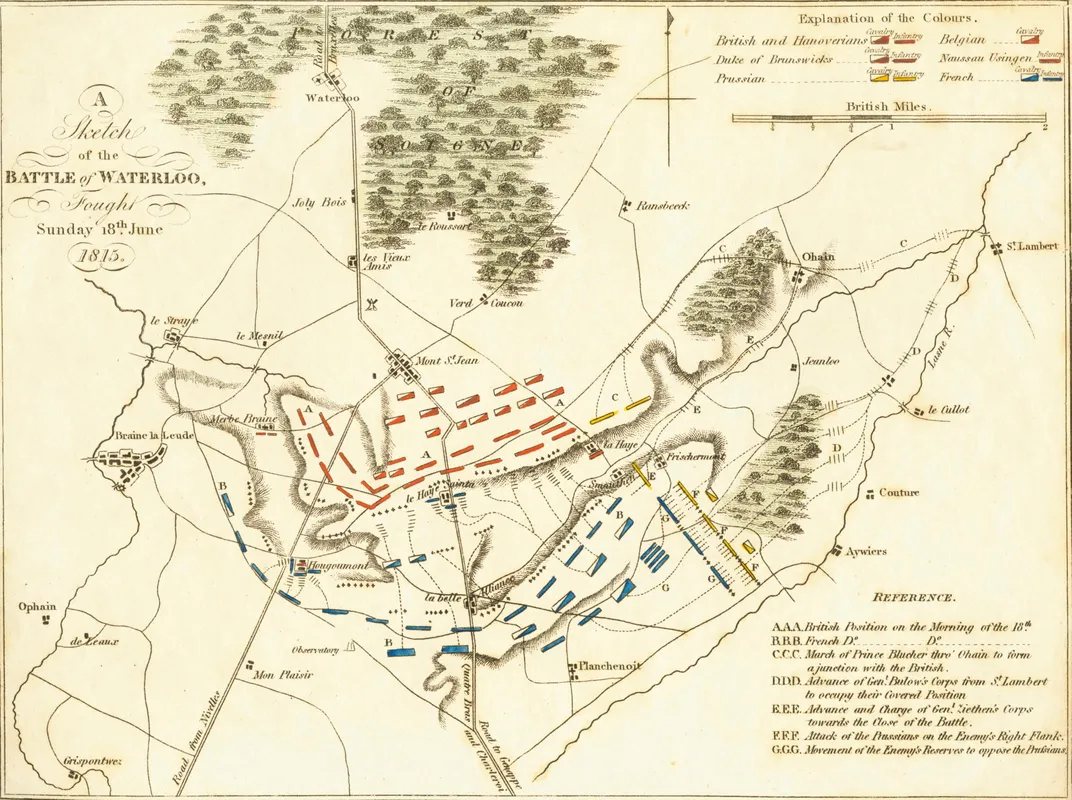
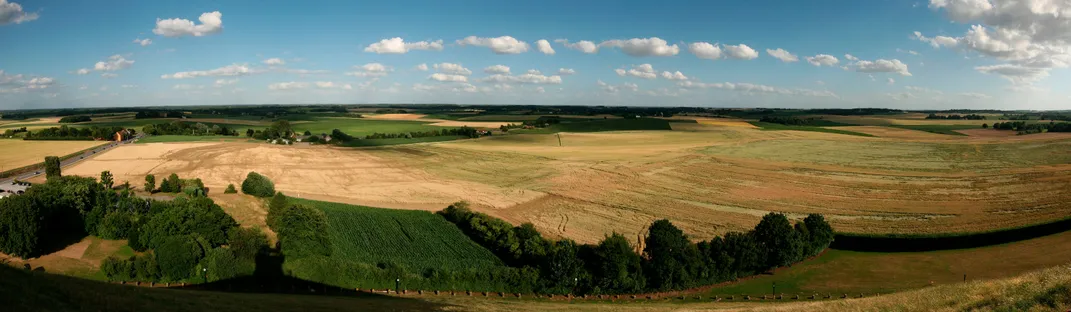
Walking the battlefield today, it's all too piece of cake to empathize why he lost. From the 140-human foot-loftier King of beasts's Mound, which was congenital in the 1820s on superlative of Wellington'southward front line, 1 can come across what Napoleon could not: the forest to the east from which 50,000 Prussians started to emerge at ane p.thousand. to stave in the French correct flank, plus the two stone farmhouses of La Haie Sainte and Hougoumont, which disrupted and funneled the French set on for nearly of the twenty-four hours.
A vast amount of literature has explored why Napoleon fought such an unimaginative, mistake-prone boxing at Waterloo. Hundreds of thousands of historians have pored over the questions of why he attacked when, where and how he attacked. Nevertheless 200 years after the fact, a dissimilar question must exist asked: Why was the Battle of Waterloo fifty-fifty fought? Was it really necessary to secure the peace and security of Europe?
**********
The future emperor of the French didn't learn to speak their language until he was sent to boarding schoolhouse at the age of 9. Information technology was non his 2nd language, simply his third. Napoleone di Buonaparte was born on August 15, 1769, on the isle of Corsica; for centuries a backwater province of Genoa, it had been sold to the French the previous yr. He grew upwards speaking the corsicano dialect and Italian, and his name was Gaulified to Napoleon Bonaparte as he and his family painfully accommodated themselves to French rule. In fact, he was extremely anti-French until the age of 20, going through a period of adolescent angst in which he identified them as the enemy of his beloved freedom-loving Corsica.
Napoleon's charming simply indolent father, Carlo, died of cancer when Napoleon was merely 15; the schoolboy had to mature early on to assistance take care of his most bankrupt family. Yet at the armed services academy at Brienne he still had time to read and reread Goethe's romantic novel The Sorrows of Young Werther, identifying with its honest but tragic hero. He later wrote his own melodramatic novel, Clisson and Eugénie, whose protagonist is a brilliant soldier crossed in dear by a gorgeous but faithless beauty, conspicuously based on Eugénie Désirée Clary, a girlfriend who had recently refused his offer of marriage.
His antipathy for the French notwithstanding, the youthful Napoleon primarily identified with the Enlightenment and the dreams of Rousseau and Voltaire. That both were forced into exile past the French State simply increased their appeal for him, as did their praise for the Corsican experiment that had been snuffed out the year earlier Napoleon was built-in. He also drew inspiration from the American Revolutionaries, who finally triumphed when Napoleon was an impressionable 14. (After George Washington died, in 1799, the recently installed French leader ordered that his nation go into x days of mourning, compared with a mere two days afterward his kickoff married woman, the empress Joséphine, died xv years later.) The French Revolution broke out with the fall of the Bastille when Napoleon was about xx; he eagerly embraced the Enlightenment ideas it at least initially represented.
Napoleon's years at Brienne and so at the École Militaire in Paris (near where the Eiffel Tower is today) taught him the essence of modern warcraft. He put that cognition to invaluable utilize in defence force of the Revolution at the Boxing of Toulon in 1793, which won him promotion to a generalship at the age of 24. Overall, he would win no fewer than 48 of the 60 battles he fought, cartoon v and losing only seven (three of which were comparatively pocket-size), establishing him every bit ane of the greatest armed forces commanders of all time.
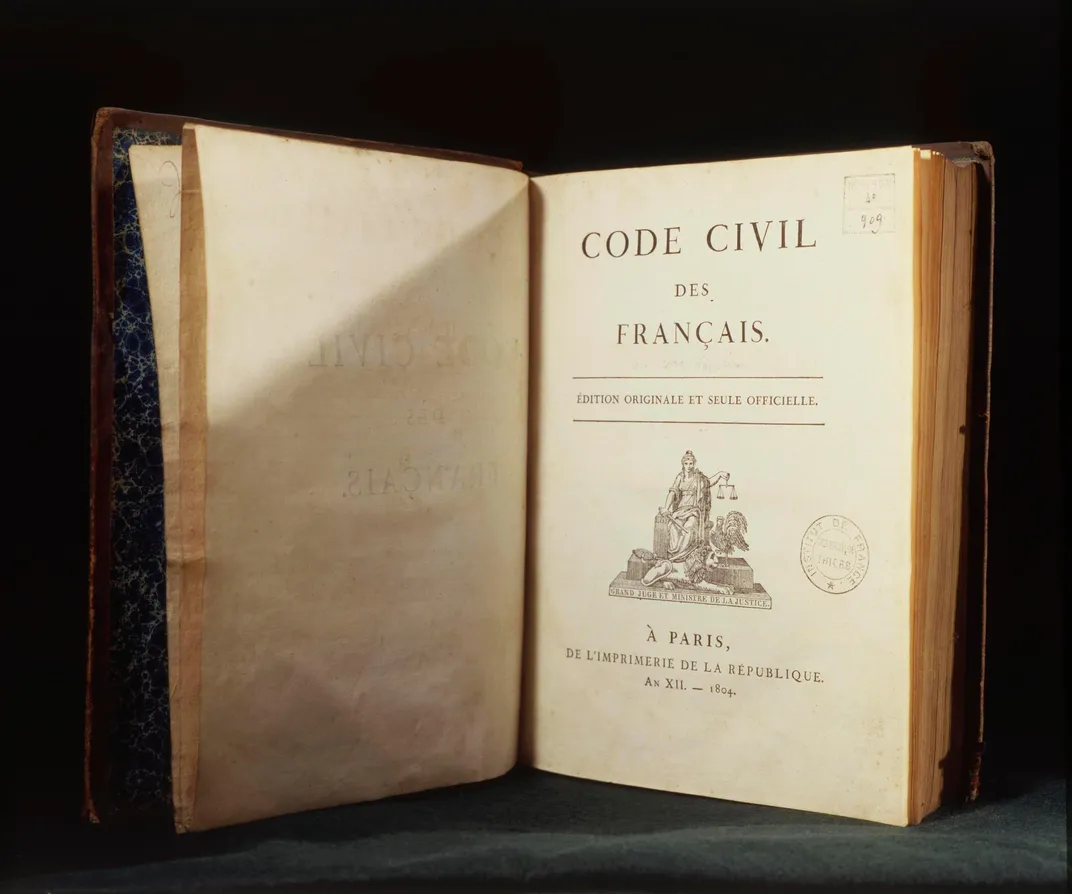
Yet he said he would exist remembered not for his military victories, simply for his domestic reforms, especially the Code Napoleon, that brilliant distillation of 42 competing and oft contradictory legal codes into a unmarried, easily comprehensible body of French law. In fact, Napoleon'due south years equally start delegate, from 1799 to 1804, were extraordinarily peaceful and productive. He also created the educational system based on lycées and grandes écoles and the Sorbonne, which put France at the forefront of European educational achievement. He consolidated the administrative system based on departments and prefects. He initiated the Quango of State, which still vets the laws of France, and the Court of Inspect, which oversees its public accounts. He organized the Banque de France and the Légion d'Honneur, which thrive today. He also built or renovated much of the Parisian architecture that we yet enjoy, both the useful—the quays forth the Seine and four bridges over it, the sewers and reservoirs—and the beautiful, such as the Arc de Triomphe, the Rue de Rivoli and the Vendôme column.
Not to the lowest degree, Napoleon negotiated the 1803 sale to the nascent United States of the vast territory called the Louisiana Buy. Americans are familiar with their side of the deal: Information technology doubled their territory overnight at less than four cents an acre and instantly established the country "among the powers of offset rank," as Robert R. Livingston, President Thomas Jefferson'due south chief negotiator, put it. But the French averted war with the United States over its inevitable expansion westward, and the 80 million francs they received allowed Napoleon to rebuild France, especially its army.
Napoleon crowned himself emperor on Dec 2, 1804, turning the French Republic into the French Empire, with a Bonaparte line of succession. He felt that this provision for continuity was prudent, given that the Bourbons launched a series of bump-off attempts on him—30 in all. Nonetheless this return to monarchy did not convalesce the ancien régime powers' rancor over the French occupation of lands in Federal republic of germany and Italy that had belonged to Republic of austria for decades. In September 1805, Republic of austria invaded Napoleon'due south marry Bavaria, and Russia declared war on France likewise. Napoleon swiftly won the ensuing War of the Third Coalition with his finest victory, at Austerlitz in 1805. The next year the Prussians besides alleged war on him, only they were soundly defeated at Jena; Napoleon's peace treaty of Tilsit with Russia and Prussia followed. The Austrians declared state of war on France once more in 1809, simply were dispatched at the Boxing of Wagram and signed yet another peace treaty.
Napoleon started none of those wars, merely he won all of them. After 1809 at that place was an uneasy peace with the three other Continental powers, just in 1812 he responded to France's being cutting out of Russian markets—in violation of the Tilsit terms—by invading Russia. That concluded in the catastrophic retreat from Moscow, which cost him more than than half a million casualties and left his Grande Armée also vitiated to deter Republic of austria and Prussia from joining his enemies Russian federation and Britain in 1813.
**********
Napoleon'southward relationship with Joséphine was not the Romeo-and-Juliet story often told. Shortly before their spousal relationship, in March 1796, he was appointed commander in chief of the Regular army of Italy, where he won an astonishing serial of more than a dozen victories confronting Austria, the papacy and local states, all the while writing her scores of erotic, emotionally needy honey letters, fifty-fifty while nether enemy fire. But within weeks his bride took a lover in Paris—the dandyish cavalry officer Lt. Hippolyte Charles, whom ane of their contemporaries said "had the elegance of a wigmaker'southward boy." When Napoleon finally institute out about the thing ii years later, he was in the middle of the Egyptian desert, on his way to Cairo. He responded by bedding Pauline Fourès, the wife of one of his junior officers—the first of no fewer than 22 mistresses over the adjacent 17 years.
When he returned to Paris a year later, Napoleon unexpectedly forgave Joséphine, and they created what amounted—his mistresses excepted—to a loving conservative family unit environment in which to heighten Joséphine's children by an earlier union at their palaces of Malmaison, Fontainebleau, the Tuileries and elsewhere. It was only in 1809, when it had become articulate that Joséphine could not bear the son Napoleon needed to continue the Bonaparte dynasty, that he reluctantly divorced her and the next twelvemonth married the Archduchess Marie Louise von Habsburg, the daughter of Emperor Francis I of Republic of austria. She chop-chop bore a son, the king of Rome.
Napoleon later said he greatly regretted not marrying instead the sister of Czar Alexander I of Russia, believing—probably wrongly—that he would not take had to invade Russia in 1812. In any result, after he retreated from Moscow, the Continental powers and the British pursued his army into French republic. The emperor's armed forces skill was intact—he won iv victories in 5 days in the Champagne region in February 1814—simply he could not forestall his boyhood friend and longtime comrade in arms Marshal Auguste de Marmont from surrendering Paris to the Austrians, Prussians and Russians the next month. Napoleon abdicated rather than plunge France into a civil war. He was exiled to the tiny Mediterranean island of Elba in May.
That calendar month Louis 18, the head of the Bourbon family, returned to France "in the luggage train of the Allies," as the contemptuous simply substantially authentic Bonapartist phrase put it. The Bourbons began ruling in France for the first time since Louis' elder blood brother Louis Sixteen and his sister-in-constabulary Marie Antoinette had been guillotined some 21 years earlier. As Napoleon adjusted to life ruling a much-reduced domain, he kept a close eye on what was happening in French republic.
It was said of the Bourbons that they "had learned nix and forgotten nothing" when they returned to ability. They had non learned from the French Revolution and Napoleonic Empire that the French people had changed profoundly and now took for granted meritocracy, low direct taxation, secular education and a certain degree of military machine glory. Nor had the Bourbons forgotten the expropriations and executions suffered by the royal family, the aristocracy and the Catholic Church during the Reign of Terror in the 1790s. Equally a result, they returned to France ill-prepared to effect a yard settlement that could reconcile the contesting demands of the regular army, clergy, aristocracy, peasantry, merchants, Bonapartists, liberals, ex-revolutionaries and conservatives.
Perhaps the task was impossible, merely later ix months information technology became clear, even on distant Elba, that Louis XVIII had failed. Napoleon was emboldened to have the last and greatest adventure of his life.
**********
On Feb 26, 1815, he secretly boarded the largest ship in his tiny fleet and sailed to Golfe-Juan, on the south declension of French republic. The British and Bourbon frigates in the surface area didn't learn of his escape until it was likewise late. Landing on March 1, Napoleon struck n with the 600 Imperial Guardsmen he had brought with him, over mountain passes and through tiny villages, sometimes on pes when the paths were as well steep and narrow to ride down. The route he took from Cannes to Grenoble—today mapped out as the Road Napoleon for tourists, hikers and cyclists—is one of the loveliest (if more than vertiginous) trails in the land.
Of class Louis XVIII sent armies to arrest him. Simply the commanders, Marshals Nicolas Soult and Michel Ney, and their men switched sides the moment they came into contact with the charisma of their former sovereign. On March 20, Napoleon reached the Tuileries Palace in Paris—on the site of the Louvre today—and was acclaimed by the populace. Col. Léon-Michel Routier, who was chatting with fellow officers nearby, recalled: "Suddenly very simple carriages without any escort showed upwards at the wicket-gate by the river and the emperor was announced....The carriages enter, nosotros all rush around them and we see Napoleon get out. Then everyone's in delirium; we jump on him in disorder, we surround him, we squeeze him, we near suffocate him." It was a "magical arrival, the result of a road of over two hundred leagues traveled in eighteen days on French soil without spilling ane drop of blood."
That night Napoleon sat down to consume the dinner that had been cooked for Louis XVIII, who had fled Paris simply hours before. Not one shot had been fired in the Bourbons' defence force. "Never before in history," said Parisian wags, "has an emperor won an empire simply by showing his hat." (Napoleon's bicorn hat had long been one of his many instantly recognizable symbols. This past Nov, one of his hats was auctioned to a Due south Korean businessman for $2.iv one thousand thousand.)
The Allies reacted with shocked atheism. They were gathered at a congress in Vienna when news of his escape reached them on March 7, just initially the representatives of Austria, Russian federation, Britain and Prussia had no idea where he had gone. Once they established iv days afterwards that Napoleon had returned to France, they issued what has been called the Vienna Declaration: "By appearing again in France with projects of confusion and disorder, he has deprived himself of the protection of the law and has manifested before the globe that there tin be neither peace nor truce with him. The Powers consequently declare that Napoleon Bonaparte has placed himself beyond the stake of civil and social relations, and that as an enemy and disturber of the tranquility of the world, he has delivered himself up to public vengeance."
This linguistic communication, which seems extremely tough to modern ears, was a compromise from a typhoon offered by the French regime, "which nearly chosen Napoleon a wild beast and invited whatsoever peasant lad or bedlamite to shoot him down at sight," as the historian Enno E. Kraehe afterward put it. The Austrian chancellor, Prince Klemens von Metternich, softened the diction because Napoleon was notwithstanding the son-in-law of the emperor of Republic of austria, and the Knuckles of Wellington denounced the linguistic communication as encouraging the bump-off of monarchs. Notwithstanding, the proclamation clearly foreclosed whatever negotiation.
On April four Napoleon wrote to the Allies, "Afterwards presenting the spectacle of groovy campaigns to the world, from now on it volition be more pleasant to know no other rivalry than that of the benefits of peace, of no other struggle than the holy disharmonize of the happiness of peoples." Past and then the Allies had already formed the Seventh Coalition to destroy him and restore the Bourbons to the French throne, in defiance of the wishes the French people had expressed in a plebiscite. Thus they made the Waterloo entrada equally inevitable as it was ultimately unnecessary.
**********
The foremost motive that the British, Austrians, Prussians, Russians and bottom powers publicly gave for declaring war was that Napoleon couldn't be trusted to keep the peace. Equally one British fellow member of Parliament put it, peace "must always be uncertain with such a man, and...whilst he reigns, would crave a constant armament, and hostile preparations more intolerable than war itself." That may take been true during his imperial period, but this time around Napoleon'southward beliefs suggested that the Allies could have taken him at his word.
He told his quango that he had renounced whatsoever dream of reconstituting the empire and that "henceforth the happiness and the consolidation" of French republic "shall exist the object of all my thoughts." He refrained from taking measures against anyone who had betrayed him the previous year. "Of all that individuals have done, written or said since the taking of Paris," he proclaimed, "I shall forever remain ignorant." He immediately set about instituting a new liberal constitution incorporating trial past jury, freedom of speech and a bicameral legislature that concise some of his ain powers; it was written by the former opposition politician Benjamin Constant, whom he had once sent into internal exile.
Napoleon well knew that after 23 years of almost abiding war, the French people wanted no more than of information technology. His greatest hope was for a peaceful menses like his days as starting time delegate, in which he could re-found the legitimacy of his dynasty, return the nation'southward battered economy to strength and restore the civil social club the Bourbons had disturbed.
And so he resumed building various public works in Paris, including the elephant fountain at the Bastille, a new market at St. Germain, the foreign ministry building at the Quai d'Orsay, and the Louvre. He sent the actor François-Joseph Talma to teach at the Conservatory, which the Bourbons had closed, and also returned to their government jobs Vivant Denon, the director of the Louvre; the painter Jacques-Louis David; the architect Pierre Fontaine; and the doctor Jean-Nicolas Corvisart. On March 31, he visited the orphaned daughters of members of the Légion d'Honneur, whose school at Saint-Denis had had its funding cut by the Bourbons. That aforementioned day he restored the Academy of France to its quondam ground, appointing the Comte de Lacépède as chancellor. At a concert at the Tuileries he kindled a romance with the celebrated 36-twelvemonth-old actress and beauty Anne Hippolyte Boutet Salvetat (whose phase proper name was Mademoiselle Mars).
All that Napoleon achieved in just 12 weeks afterwards he returned to Paris—even as he prepared for the state of war the Allies had declared on him.
Similar the Bourbons, they were in no mood to forgive or forget. In addition to their alleged distrust, they had less-public motives for moving against him. The autocratic rulers of Russia, Prussia and Republic of austria wanted to crush the revolutionary ideas for which Napoleon stood, including meritocracy, equality before the law, anti-feudalism and religious toleration. Essentially, they wanted to turn the clock back to a time when Europe was condom for aristocracy. At this they succeeded—until the outbreak of the Great War a century afterwards.
The British had long enjoyed most of the key Enlightenment values, having beheaded King Charles I 140 years before the French guillotined Louis Xvi, but they had other reasons for wanting to destroy Napoleon. Annihilation that distracted the British public's attending from Andrew Jackson's victory at New Orleans in January 1815 was very welcome, non least because the British commander there, Gen. Edward Pakenham, was the Knuckles of Wellington'due south brother-in-law. More than gravely, U.k. and France had fought each other for no fewer than 56 years in the preceding 125, and Napoleon himself had posed a threat of invasion before Lord Nelson destroyed the French and Castilian fleets at Trafalgar in 1805. With the French threat removed, the British were able to sign a peace treaty securing strategically important points around the globe, such every bit Cape Town, Jamaica and Sri Lanka, from which they could project their maritime power into a new empire to supervene upon the one they'd lost in America. They, too, succeeded, building the largest empire in earth history, which by the dawn of the 20th century covered nearly a quarter of the world'south land surface. The British could have accomplished those goals even if they'd left Napoleon solitary; they had total control of the oceans.
Once it became clear that the Allies were amassing huge armies to invade France and depose him once more, Napoleon acted swiftly, leaving Paris on June 12 and striking north to defeat the Anglo-Centrolineal army under Wellington and the Prussian Army under von Blücher earlier the Austrian and Russian armies, totaling half a million men, could arrive.
**********
Wellington subsequently described the Battle of Waterloo as "the nearest-run thing you lot always saw in your life." Initially, the French outnumbered their opponents, peculiarly in artillery. They were a homogeneous national forcefulness, and their morale was high, since they believed their commander was the greatest soldier since Julius Caesar. The first stages of the Waterloo entrada also saw Napoleon returning to the all-time of his strategic abilities. He wanted to fight in modern-day Belgium (then officially known as the Austrian Netherlands, though they no longer belonged to Austria) because the British and Prussian troops were far apart, and because capturing Brussels would be a slap-up boost to French morale and might force the British Ground forces off the Continent birthday. By achieving a vivid feint toward the w, he managed to steal a day's march on Wellington. "Napoleon has humbugged me, by God," the Briton exclaimed.
Napoleon wanted to strike at the hinge between the Prussian and British armies, as he had washed on other battlefields for well-nigh xx years, and at first it seemed as if he'd succeeded. At the Battle of Ligny on June 16, he pinned the Prussians in place with a frontal attack and ordered a corps of twenty,000 men under Gen. Jean-Baptiste d'Erlon to autumn on the enemy'due south exposed correct flank. Had d'Erlon arrived equally planned, it would have turned a respectable victory for Napoleon into a devastating rout of the Prussians. Instead, just as he was about to engage, d'Erlon received urgent orders from Marshal Ney to support Ney miles to the westward, and so d'Erlon marched.
"Incomprehensible solar day," Napoleon later said of that fateful June xviii, admitting that he "did non thoroughly understand the battle," the loss of which he blamed on "a combination of boggling Fates." In fact, it was not incomprehensible at all: Napoleon carve up his army disastrously the solar day before the battle, put his senior marshals in the incorrect roles, failed to set on early enough in the morning, didn't discern that the Prussians were going to get in in the afternoon, launched his major infantry attack in the wrong germination and his major cavalry attack at the wrong fourth dimension (and unsupported by infantry and horse artillery), and unleashed his Imperial Guard besides tardily. As he told one of his captors the following year: "In war, the game is always with him who commits the fewest faults." At Waterloo, that was undoubtedly Wellington.
If Napoleon had remained emperor of France for the six years remaining in his natural life, European civilisation would have benefited inestimably. The reactionary Holy Alliance of Russia, Prussia and Republic of austria would non have been able to crush liberal constitutionalist movements in Spain, Greece, Eastern Europe and elsewhere; force per unit area to join French republic in abolishing slavery in Asia, Africa and the Caribbean would have grown; the benefits of meritocracy over feudalism would have had time to become more widely appreciated; Jews would non have been forced back into their ghettos in the Papal States and made to vesture the yellow star over again; encouragement of the arts and sciences would have been ameliorate understood and copied; and the plans to rebuild Paris would take been implemented, making it the virtually gorgeous city in the earth.
Napoleon deserved to lose Waterloo, and Wellington to win information technology, but the essential point in this bicentenary yr is that the ballsy battle did not need to be fought—and the earth would accept been better off if it hadn't been.
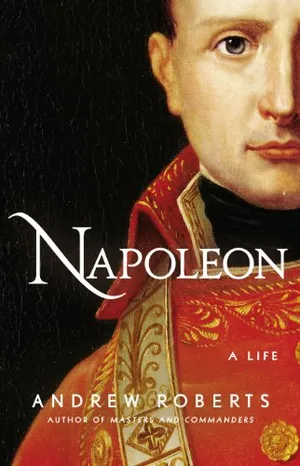
Napoleon: A Life
yarbroughancon1962.blogspot.com
Source: https://www.smithsonianmag.com/history/we-better-off-napoleon-never-lost-waterloo-180955298/
/https://tf-cmsv2-smithsonianmag-media.s3.amazonaws.com/filer/37/f7/37f76041-e0f6-4087-8388-ec211c26a9fb/jun2015_j04_waterloo.jpg&description=what were the two defeats that led to napoleons losing paris and exile)
Postar um comentário for "what were the two defeats that led to napoleons losing paris and exile"